


Vercel vs Serversinc
Vercel runs your frontend and functions on its network. Serversinc runs your long-lived containers on servers you own.
Checked against Vercel's public pricing and docs on 2026-09-27.
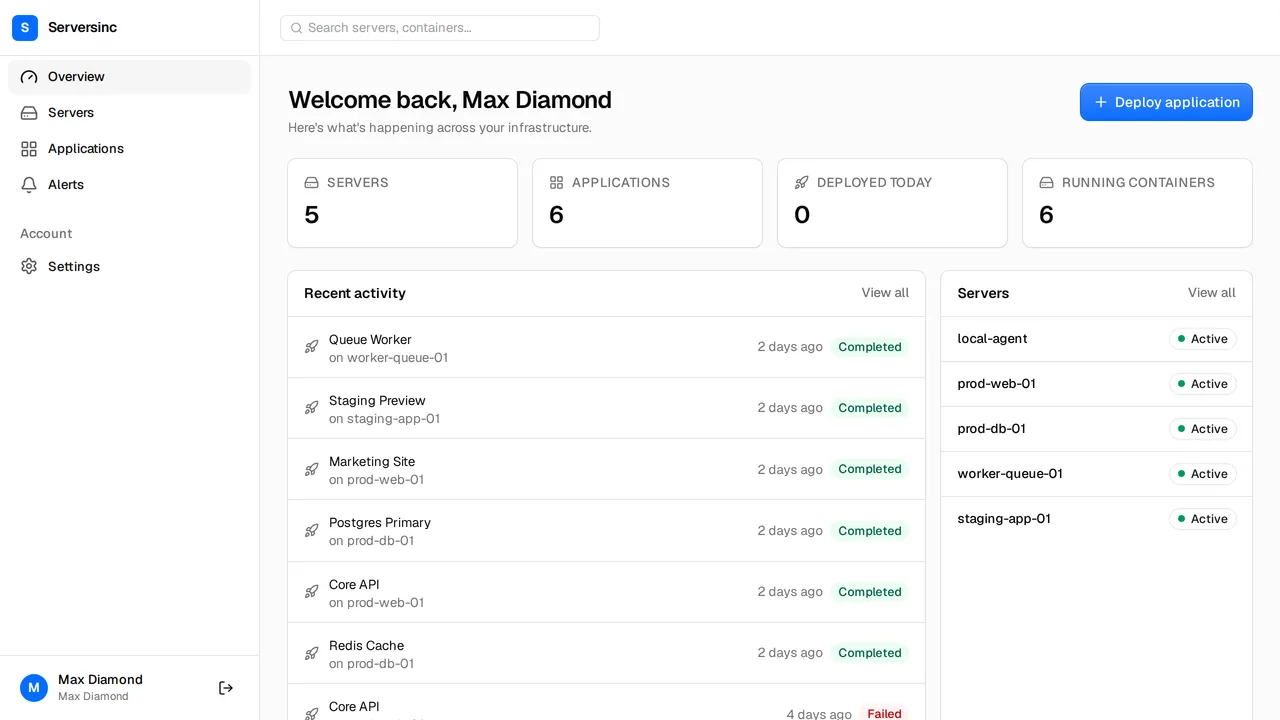
What Vercel is, and what Serversinc is
Both get your apps running. Here is how each one does it.
Vercel is a frontend cloud. It builds your framework app, serves it from a global CDN and runs your backend code as functions, with a preview URL for every pull request. Pro is $20 a month per deploying seat, and usage past the $20 credit is billed per unit.
Serversinc gives you a managed deploy flow on servers you own. It runs any Docker image as a long-lived container, so APIs, workers and databases sit on the same box. You pay £5 a month for your first three servers and £2 for each after, and seats aren't billed.
What the bill looks like
Vercel Hobby is free for personal, non-commercial projects. Pro is $20 a month with one deploying seat and $20 of usage credit, and each extra deploying seat is $20. Past the credit, usage is billed per unit: data transfer from $0.15 per GB after 1 TB, Active CPU from $0.128 an hour and function invocations from $0.60 per million.
- Platform fee
- Vercel $0 Hobby (non-commercial), $20/mo Pro with $20 usage credit Serversinc £5/mo for three servers
- Seats
- Vercel $20/mo per extra deploying seat; viewers free Serversinc Up to 10, no seat charge
- Compute
- Vercel Active CPU from $0.128/hr, memory from $0.0106/GB-hr, invocations from $0.60 per million Serversinc Your server at your provider's price; run as many apps as fit
- Data transfer
- Vercel 1 TB included on Pro, then from $0.15 per GB Serversinc Not billed by Serversinc; your provider's terms apply
- Build minutes
- Vercel From $0.014 per minute on Pro build machines Serversinc Builds run on your server, not billed
List prices in each vendor's own currency. Server costs from your cloud provider are billed separately on both sides unless stated.
Side by side
Deploys, databases, backups, alerts and automation.
- Where apps run
- Vercel Vercel's CDN and function regions Serversinc Servers you own, at any provider and in any region they offer
- What it runs
- Vercel Frontend frameworks and functions, up to 800 seconds a run on Pro Serversinc Any Docker image, running as long as you need: APIs, workers, queues and schedulers
- Sources
- Vercel GitHub, GitLab, Bitbucket and the CLI; framework builds Serversinc GitHub with a Dockerfile, and Docker images from any registry
- Previews
- Vercel A preview deployment for every branch and pull request Serversinc Deploys from a branch or image tag; run staging as its own application
- Databases
- Vercel Postgres, Redis and more through Marketplace partners, billed by them Serversinc Provision Postgres, MySQL or MariaDB on your server with users, schemas and grants
- Backups
- Vercel Handled by each Marketplace provider Serversinc Scheduled database and volume backups to an S3-compatible bucket you own
- Automation
- Vercel REST API, CLI, deploy hooks and an MCP server Serversinc REST API, per-application deploy triggers and an MCP server
Both are good tools. Pick the one that fits.
Where each one is the stronger choice, stated plainly.
Pick Vercel if
- You ship a Next.js or other frontend framework and want it on a global CDN.
- You want a preview URL on every pull request.
- Your backend fits in functions that finish within minutes.
- You never want to own or patch a server.
Pick Serversinc if
- You run APIs, workers, queues or WebSocket servers that stay up all day.
- You want your database on the same server as the app.
- Your team has several deployers and you don't want a bill per seat.
- You want the bill to follow server count, not CPU hours, invocations and bandwidth.
Vercel vs Serversinc, answered
Connect your first server
Import a server you already run, or provision one on your own cloud account. The first three servers are £5 a month.